AI - EDITION BERLIN
Taketo Muroi - Afterimage 5
Taketo Muroi - Afterimage 5
Couldn't load pickup availability
Technique: Promptography on Hahnemühle Fine Art paper
Image size: 45 x 30 cm
Edition: 3 + 1 AP
Year: 2025
Afterimage 5
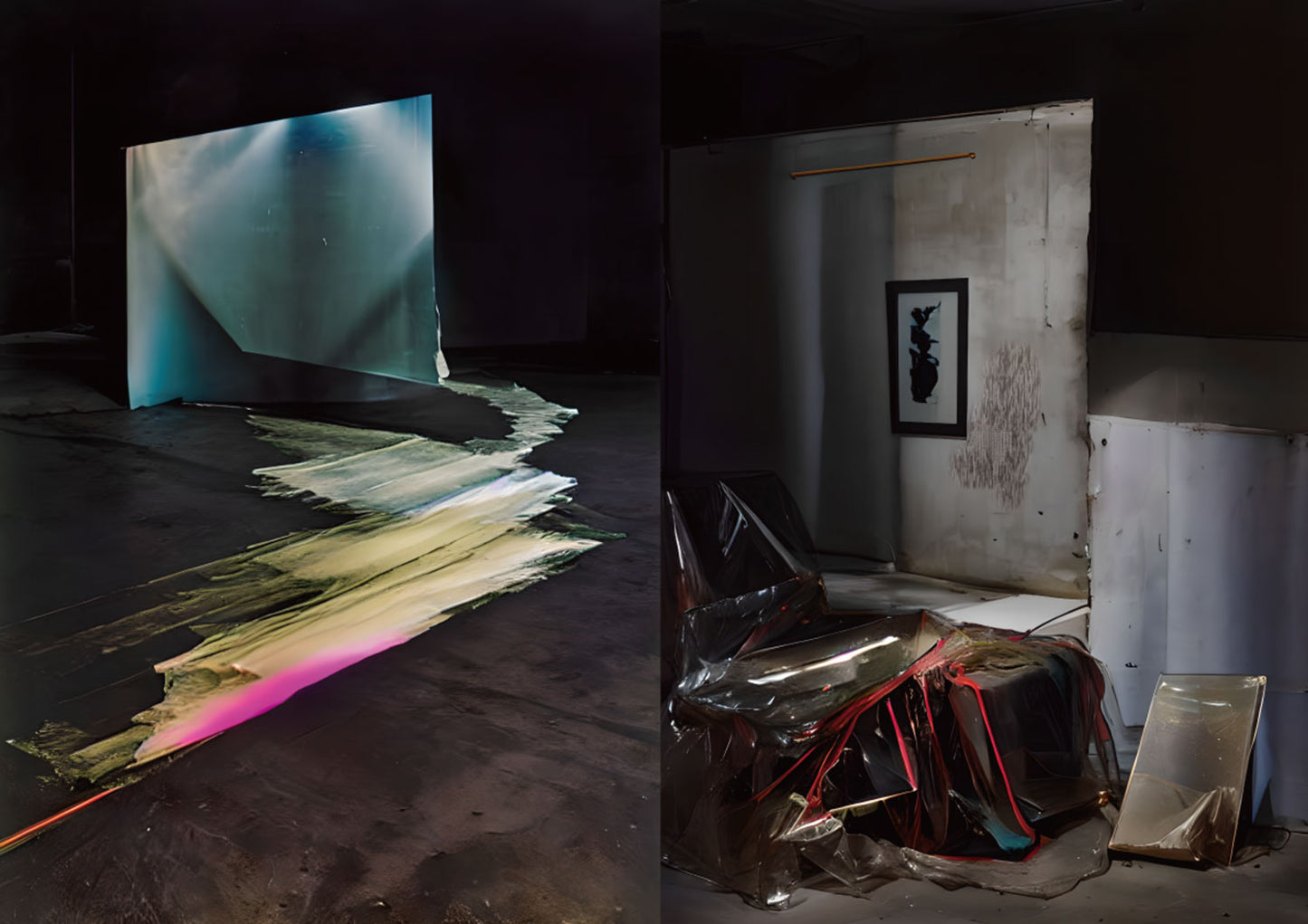
Afterimage 5 condenses the central question of the series into a particularly material and simultaneously self-reflexive constellation. The division of the image into two parts functions here as a clear dividing line between two states of imagery: on the left, the image as a fleeting projection; on the right, the image as a damaged object.
The left half of the image shows a large, slightly tilted surface, its surface interwoven with soft color gradients and light reflections. The image seems to detach itself from the surrounding space: it tilts, liquefies, and virtually flows out. The colored stripe extending from the bottom edge into the space acts like an afterimage in the physiological sense—a trace that remains after the actual image has already disappeared. Perception here appears as a temporal process, not as a stable moment.
In contrast, on the right is a scene that presents the image as a material relic. Torn, deformed, and plastic-coated picture supports lie or lean in the room. Cables, tensions, and fractures are visible. A framed fragment of an image hangs on the wall—small, isolated, almost lost. This half of the image does not address seeing, but rather the failure of the image: its vulnerability, its dependence on supports, spaces, and technical conditions.
The juxtaposition creates a precise commentary on the present state of photographic and AI-supported image production, as examined by Taketo Muroi . While on the left the image appears as an immaterial phenomenon and algorithmic simulation, the right side shows the return of the real in the form of weight, material, and decay. One exists only in the moment of perception, the other remains as a damaged object.
Afterimage 5 thus explores the tension between digital transcendence and physical reality. The afterimage here is not merely an optical phenomenon, but a media-critical state: images do not survive as clear statements, but as fragile traces – between projection and ruin, between light and burden.
Share