AI - EDITION BERLIN
Taketo Muroi - Afterimage 4
Taketo Muroi - Afterimage 4
Couldn't load pickup availability
Technique: Promptography on Hahnemühle Fine Art paper
Image size: 45 x 30 cm
Edition: 3 + 1 AP
Year: 2025
Afterimage 4
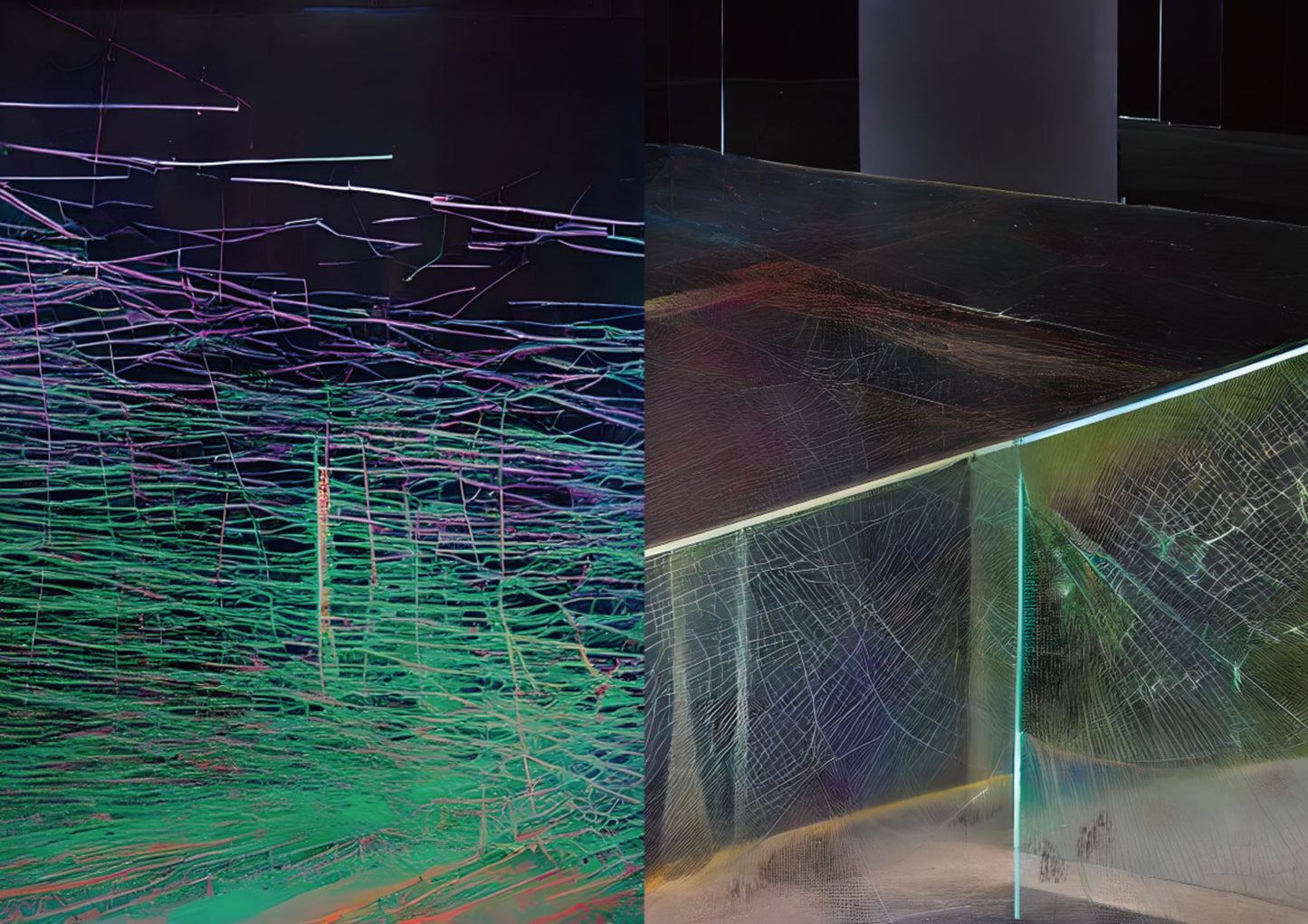
Afterimage 4 consistently continues the serial logic of the series while simultaneously sharpening the focus on the conceptual difference between the two halves of the image. Here, the division functions less as a formal device than as an analytical tool with which Taketo Muroi juxtaposes two fundamentally different states of the image.
The left side of the image displays a dense network of lines, traces, and colored overlays. Green, violet, and cyan tones permeate the image like electrical currents or cartographic markers. The lines appear to have neither beginning nor end; they evoke neural networks, data streams, or motion recordings without bodies. This visual field appears unstable, process-oriented, and temporally open—a visual record of algorithmic activity in which perception is not fixed but constantly recalculated.
In contrast, the right half of the image presents a significantly calmer, more spatially legible structure. Transparent surfaces, clean edges, and an almost architectural perspective create the impression of an interior space or an installation. The surface is crisscrossed with fine scratches that appear like sedimented time—traces of use, touch, or wear. Lines of light and reflections structure the space and lend it a fragile depth that oscillates between materiality and illusion.
The juxtaposition of these two sides creates a tension between movement and stillness, between the abstract world of data and physical experience. The left image is a pure afterimage—a visual echo of processes that elude human perception. The right image, on the other hand, suggests presence and physicality without ever fully realizing them. Both sides remain fragments, incomplete and interdependent.
Afterimage 4 thus reflects the conditions of contemporary image production: images no longer emerge as self-contained units, but as transitional states between calculation, perception, and memory. Here, the afterimage is not a residue, but the very state of the image – a state of suspension between what was and what only takes shape in the act of seeing.
Share