AI - EDITION BERLIN
Taketo Muroi - Afterimage 10
Taketo Muroi - Afterimage 10
Couldn't load pickup availability
Technique: Promptography on Hahnemühle Fine Art paper
Image size: 45 x 30 cm
Edition: 3 + 1 AP
Year: 2025
Afterimage 10
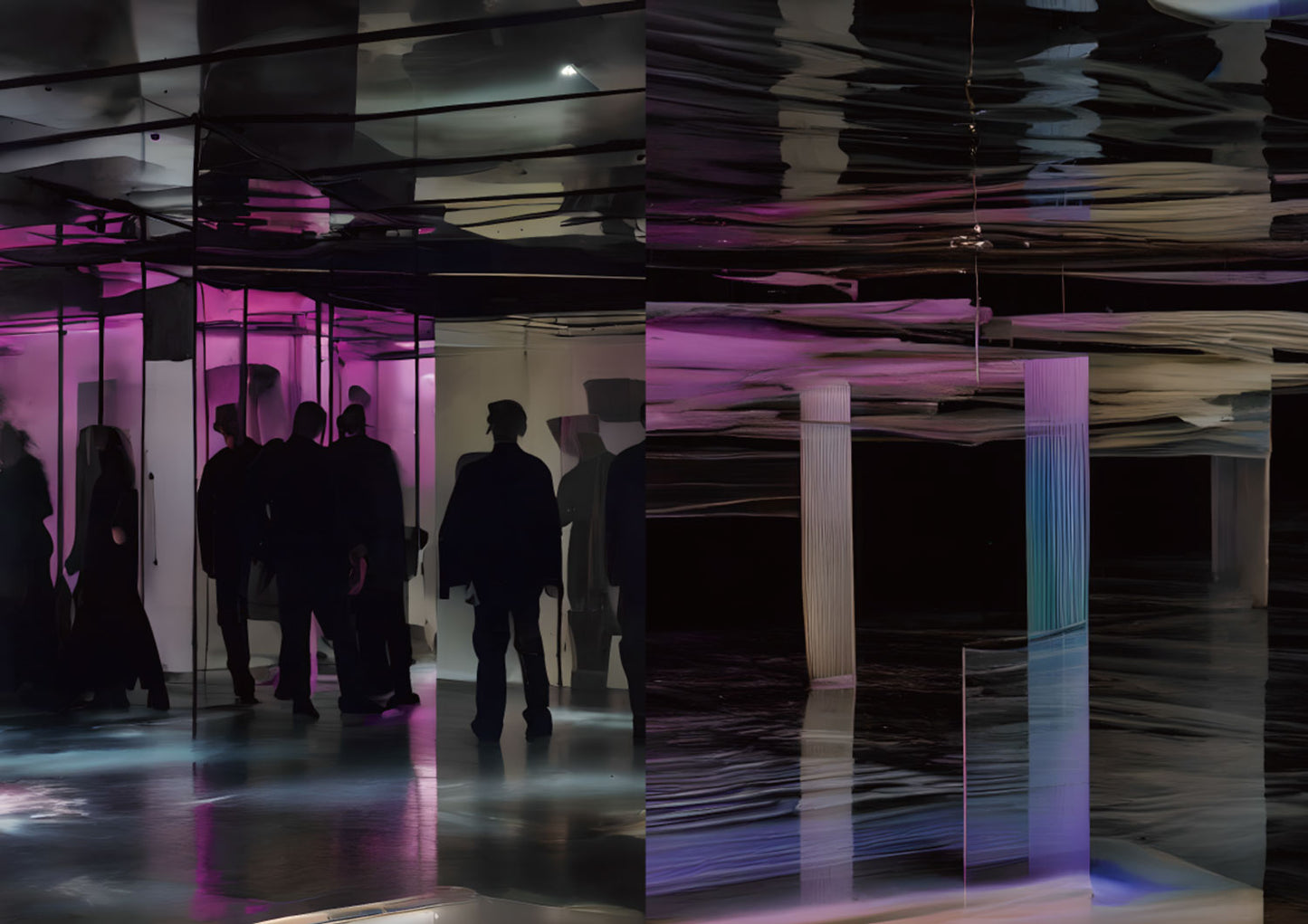
Afterimage 10 forms one of the most complex nodes within the series. The strictly bipartite composition functions here not only as a formal principle, but also as an epistemic threshold between social experience and abstract pictorial order.
The left half of the image depicts a group of people in an architecturally open space. Their bodies appear as dark silhouettes, frozen in a moment of transition: standing, walking, waiting. The pinkish-violet light bathes the scene in an artificial atmosphere reminiscent of exhibition spaces, temporary installations, or urban liminal zones. Reflections on the floor and walls multiply the figures, dissolve individual contours, and allow the bodies to become part of a larger field of perception. Presence here is relational—the individual exists only within the interplay of space, light, and other bodies.
In contrast, the right half of the image presents a radical abstraction of the same situation. Vertical, column-like forms appear to emerge from a fluid, layered surface. Colors run horizontally, as if they were sedimented traces of time or distorted data sets. Here, architecture appears dematerialized: it is no longer built, but calculated. Space is created not by walls, but by layering, transparency, and repetition.
In the logic of Japanese animism, this division can be interpreted as a transition from animate social space to animate material. Even the abstract is not inert here—color, light, and structure possess their own efficacy. The pillars are not objects, but states, bearers of an invisible presence. From a Zen Buddhist perspective, the work points to the dissolution of the dualism of subject and object: the human being on the left and the structure on the right are not opposites, but different manifestations of the same reality.
Media-critically, Afterimage 10 reflects on the transformation of community in the digital age. Social experience is increasingly overlaid, translated, and abstracted by algorithmic spaces. Encounters leave an afterimage—not as a memory, but as a data structure. What remains is not a definite place, but a suspended state between physical presence and media representation.
For Taketo Muroi, this afterimage is not a loss, but a symptom of our present: perception is fragmented, relational, and unstable. Afterimage 10 does not show what we see, but how seeing is formed today – in the tension between body, space, and algorithmic order.
Share