AI EDITION BERLIN
JULIEN BONET - Terrorist
JULIEN BONET - Terrorist
Couldn't load pickup availability
Technique: Promptography on Hahnemühle Fine Art paper
Size: 50 x 40 cm
Edition: 3 + 1 AP
Year: 2024-25
Signed, dated and edition numbered by the artist on a separate label.
terrorist
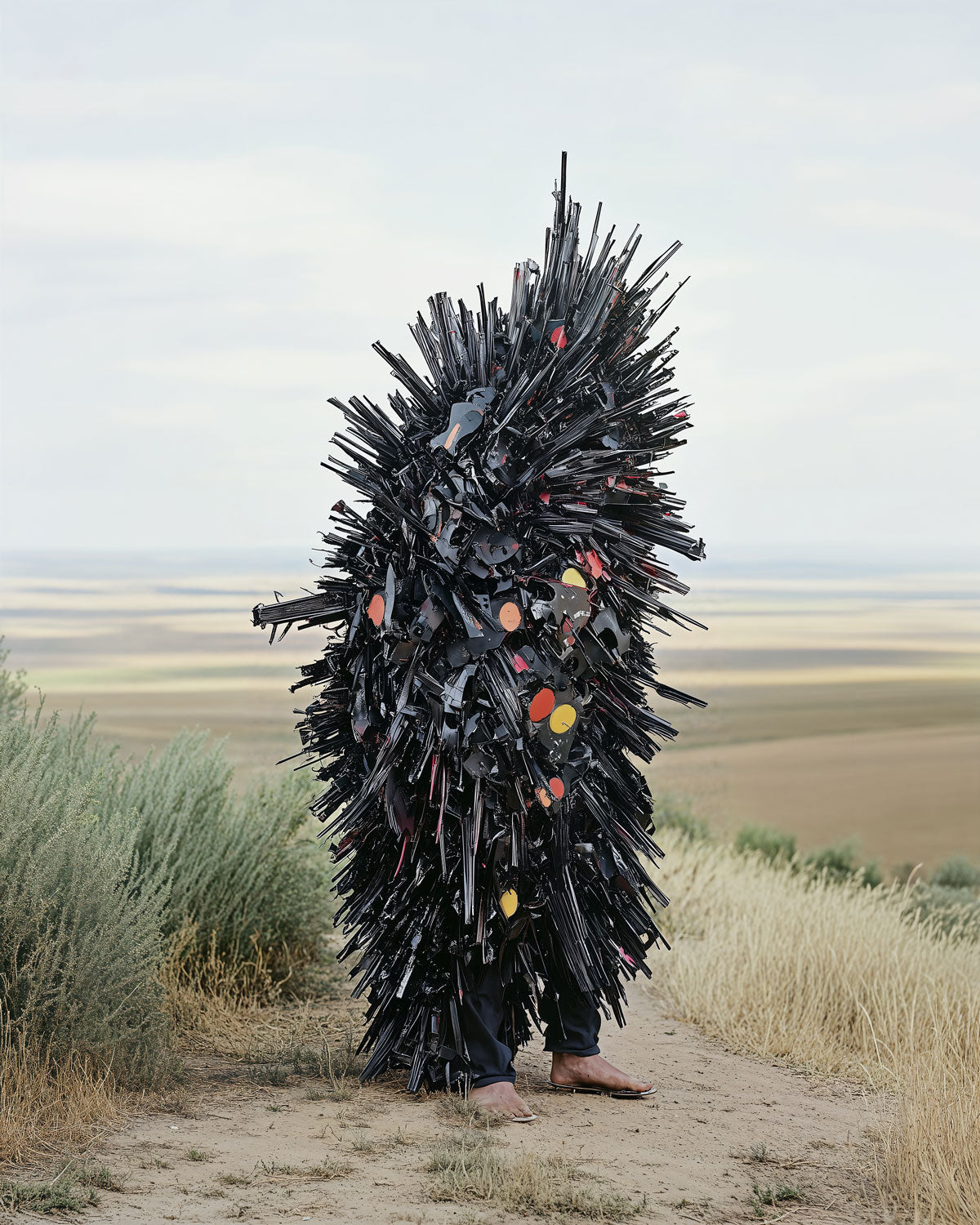
A menacing silhouette of black splinters, studded with bright dots, like warning signals or target markers. Bonet's terrorist stands there, misshapen yet precisely staged—a body completely absorbed in symbols of violence and fear. No identity, no face, merely an echo of the media cipher "terrorist."
This figure is more than a depiction of extremism; it is a commentary on the mechanism of fear production. In a world where the word "terrorist" has long been a political tool—used to justify wars, expand surveillance, and close borders—Bonet points to the ambivalence of the term. Who decides who is a "terrorist"? The state, the media, the victors of history? The black, spiky surface acts as a defense mechanism—a body that radiates violence and attracts violence, a mirror for projections of collective paranoia.
The figure is deeply rooted in history: from anarchist assassins of the 19th century to state terror regimes of the 20th century to the asymmetric wars of our present day. But Bonet's mask removes time from the image: Here, terror is not fixed geographically or ideologically, but presented as a universal principle—a strategy that can mark both power and powerlessness.
Socioculturally, the work touches on the normalization of fear: airports, big cities, public celebrations—the presence of "terrorism" is not only physically but psychologically omnipresent. The terrorist in Bonet's Masqueraders cycle is not a real individual, but a collective fiction, a construct that simultaneously divides societies and welds them together. He poses the uncomfortable question: Do we need this figure to define our own "civilization"?
In the context of the series, the terrorist acts as a counterpoint: where other masks negotiate pain, survival, or identity, this figure harnesses fear as political capital—and forces us to reflect on the power of images we ourselves produce.
Share